Killa Design: from Museum of the Future to Amali Residences
The Museum of the Future opened in Dubai in 2022 and became, within months, one of the most photographed buildings of the decade. Behind it stands Killa Design, founded by South African architect Shaun Killa. Amali Residences on the Dubai Water Canal is the practice's latest residential statement, and it carries the same architectural language that made the museum a global icon.
Shaun Killa and the founding of the practice
Shaun Killa trained as an architect in South Africa and built early credentials on sustainability-led projects across the Gulf and Africa. He founded Killa Design in Dubai with the conviction that the region needed an architectural voice that would compete on global stages rather than import foreign signatures. The practice has remained boutique by choice, with a tight team and a portfolio curated around ambitious civic and luxury projects.
Within a decade, Killa Design has become one of the few Dubai-based studios consistently mentioned alongside Foster, Zaha Hadid Architects and OMA when iconic projects are commissioned in the city. The trajectory is rare and deliberate.
Museum of the Future: the icon
The Museum of the Future is the project that put Killa Design on the world map. The torus form, the calligraphic façade by artist Mattar bin Lahej, the column-free interior, and the absence of visible structural elements made the building a structural and aesthetic feat. National Geographic listed it among the 14 most beautiful museums in the world. Visitors crossed several million in the first two years.
Beyond the visual impact, the building is also a sustainability statement. LEED Platinum certified, integrating solar generation, advanced façade engineering and passive cooling, the museum operates as a working demonstration of the architectural standards Killa Design pursues. Form, narrative and performance are aligned rather than separated.
A wider portfolio across the MENA region
The Office of the Future, also in Dubai, was the first fully functional 3D-printed office building. It opened with the Dubai Future Foundation and remains a reference for additive construction at scale. Killa Design has also delivered the corporate headquarters for the Roads and Transport Authority, multiple hospitality interiors, and master plans across the Gulf.
Residential commissions have followed, with a clear pattern. The practice takes on private projects only when the brief allows the architecture to set the tone of the place, not adapt to a generic template. Amali Residences fits that filter.
The Killa Design philosophy
Three principles run through the practice. Sculptural geometry: forms that read clearly from afar and reward closer reading at the detail scale. Organic continuity: surfaces that flow rather than meet at hard corners, with curves that integrate structure, façade and skyline. Performance-first sustainability: every project is engineered for the climate it sits in, with passive shading, thermal mass and energy systems planned at concept stage, not retrofitted.
The result is recognisable. A Killa Design building is rarely mistaken for the output of another studio. That recognisability is itself an asset for residential investors who care about long-term identity.
How the DNA translates to Amali Residences
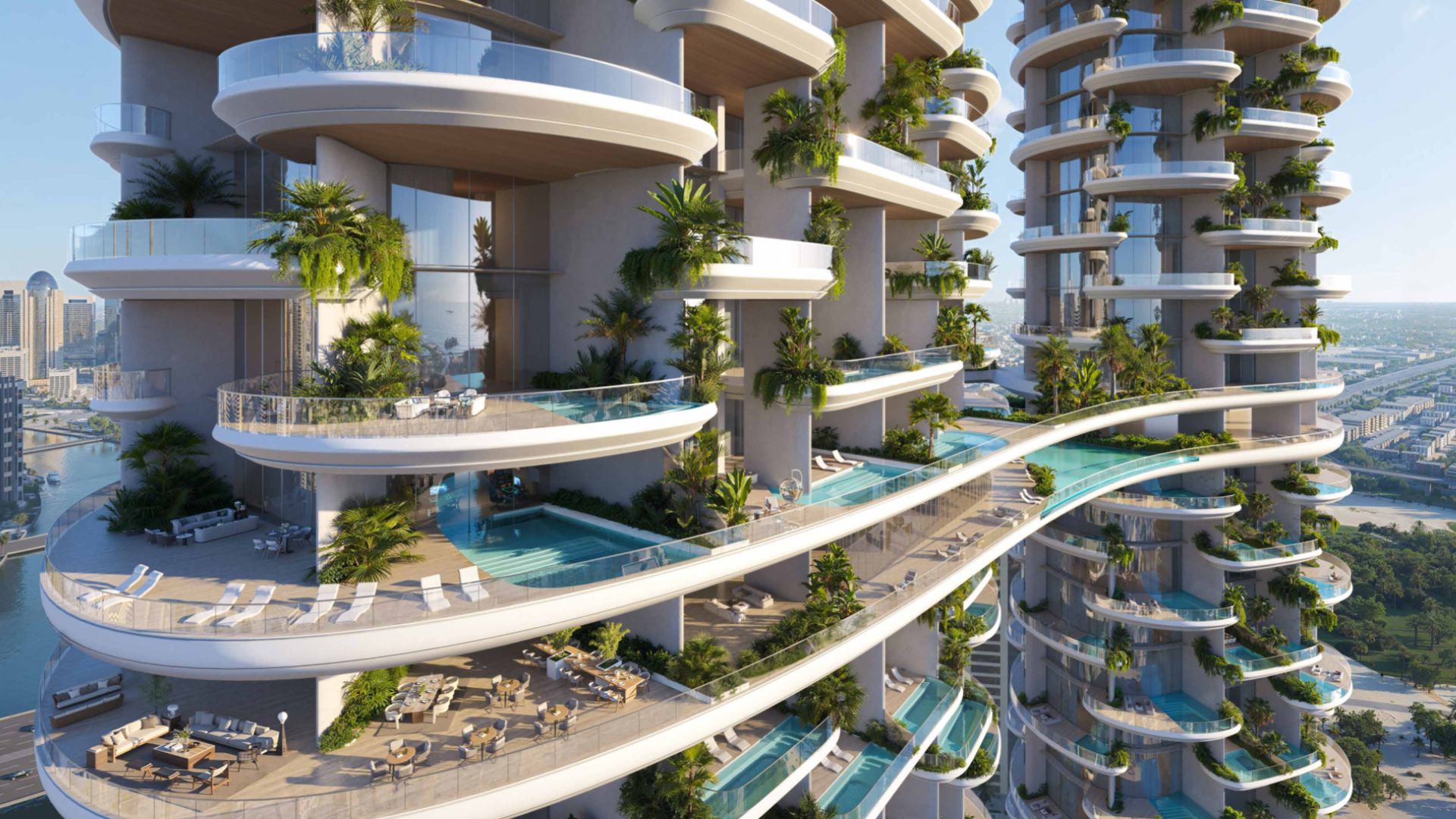
Amali Residences is built as two towers connected by a continuous wellness podium. The podium is not a parking deck dressed with greenery, it is the architectural and social spine of the project. The two towers rise above it with a sculpted profile and balconies that flow horizontally along the façade rather than stack as discrete trays.
The signature Japanese garden at podium level is a direct expression of the Killa Design ethos: a sculptural landscape integrated into the architecture, not a decorative add-on. Water features, stone composition and curated planting form an outdoor room that anchors the project at the human scale, while the towers handle the skyline scale.
Inside the units, 5.5 metre floor-to-floor heights and full-height glazing give the interiors a volumetric quality that mirrors the exterior continuity. Private pools on terraces extend the residence into the air, which is consistent with how Killa Design treats indoor-outdoor transitions across its civic work.
Why this matters for a buyer
Architecture is not a soft attribute in ultra-prime real estate, it is a primary value driver. A building signed by a studio with civic credentials at the level of Museum of the Future carries identity that survives market cycles. For the Dubai Water Canal corridor, where multiple branded residences compete on interior brand alone, an authored building delivers a different kind of differentiation.
Contact
If you would like to receive the full Amali Residences brochure and discuss availability with an advisor, contact us at contact@amali-residences.ae.